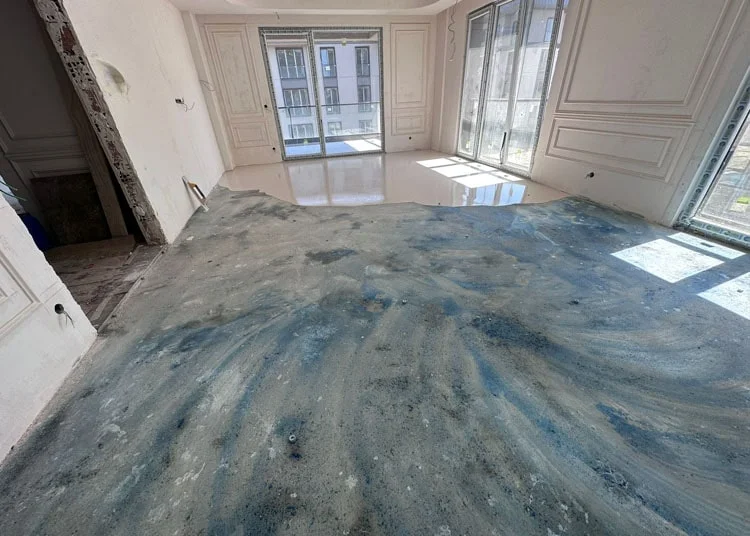
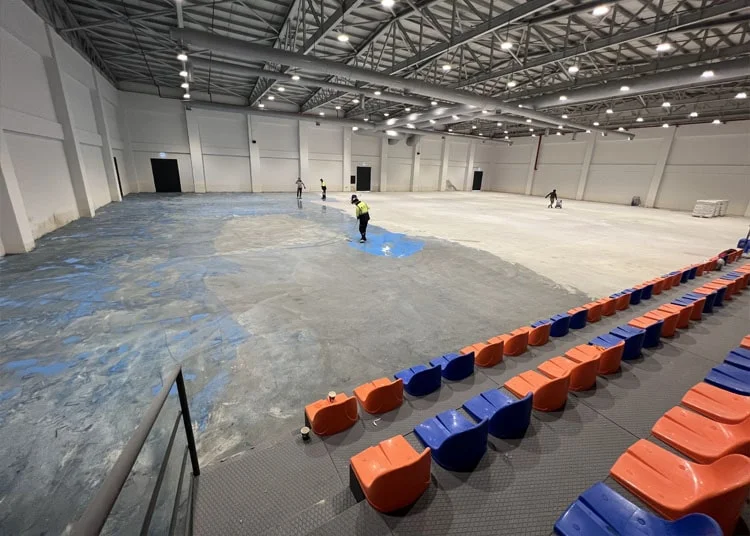
Surface Cleaning
The substrate surface where self-leveling screed will be applied must be clean, dry, and sound.
Any materials on the floor that may reduce adhesion, such as gypsum, paint, lime, cement laitance residues, bitumen, silicone, oil, grease, or rust, must be removed using tools such as scrapers or rotary hammer drills. The substrate must be thoroughly cleaned and free from dust, oil, dirt, and similar contaminants.
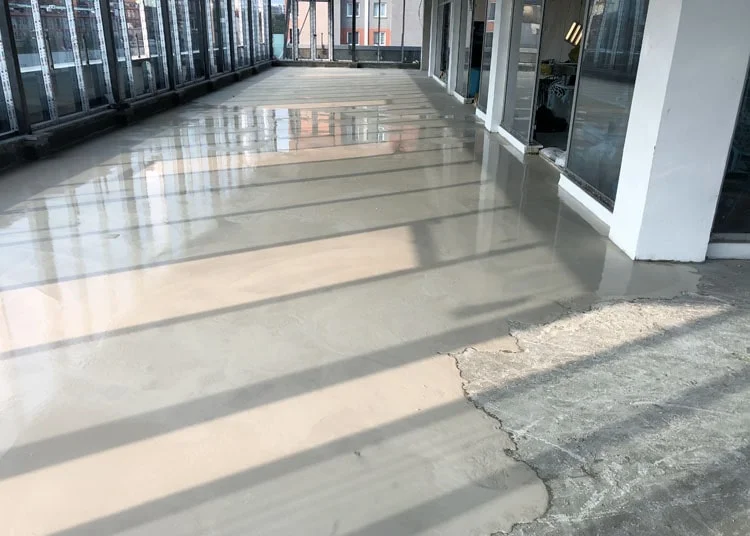
If there are loose areas or localized defects on the substrate, they must be repaired with repair mortar before applying the self-leveling screed.
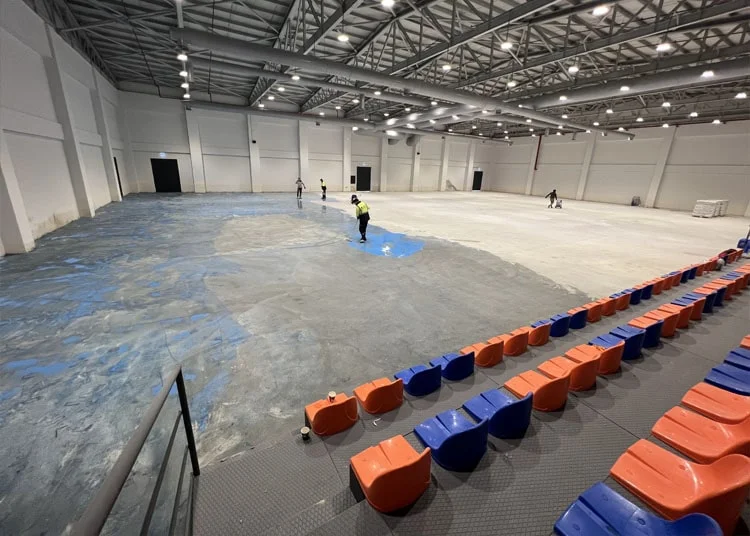
Before application, the floor must be primed with an adhesion-promoting primer.
The area where self-leveling screed will be applied must be checked before application by carrying out a level survey to assess the condition of the floor.
In large areas, grid sections should be created to determine the application levels.
Floor Priming
1- Ensuring Good Adhesion: Floor priming is important to allow the self-leveling screed to bond perfectly with the substrate. The primer prepares the surface and provides excellent adhesion for the screed. This ensures that the screed is long-lasting and firmly bonded to the surface.
2- Controlling the Absorbency of the Substrate: Floor priming is used to control the absorbency of the substrate. The primer reduces the water absorption of the floor, helping the self-leveling screed cure evenly. Otherwise, the substrate may absorb the water from the screed too quickly, resulting in uneven drying.
3- Filling Surface Cracks and Holes: The primer can help fill small cracks and holes in the floor, creating a smoother surface. This allows the self-leveling screed to spread more evenly and form a flat floor.
4- Preventing Chemical Reactions in the Substrate: Floor priming is also used to prevent chemical reactions in the substrate. Especially on concrete floors, it helps prevent alkaline reactions that may originate from the concrete and improves the quality of the screed.
Level Survey
After the device calibrates itself and the process begins, the floor is measured at 1-meter intervals. A folding wooden ruler or a standard measuring tape is held at a 90-degree vertical angle to the floor, and the values indicated on the measuring tool are read in millimeters. If there is a layout plan of the area, the readings are marked on the plan. If no plan is available, the architecture of the area is drawn on a blank sheet of paper, and the measured values are written one by one on the corresponding points.
After the entire area is surveyed at 1-meter intervals, the highest and lowest points are determined based on the measured values. If necessary, material consumption is estimated accordingly. However, the exact consumption is determined based on the amount of material used during the application and invoiced accordingly.
Application Details
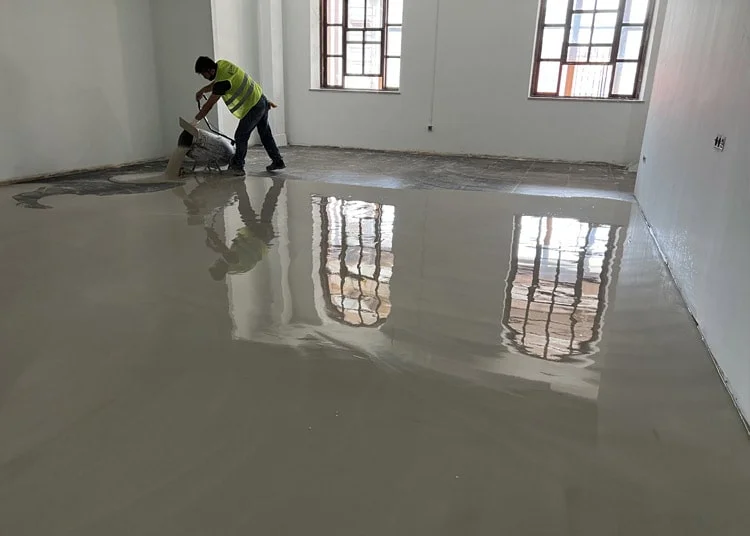
After the primed floor has dried, the prepared material is poured and spread using a trowel or notched trowel.
Air bubbles on the surface of the spread screed are removed using a spiked roller.
The material mixed in a clean bucket, drum, or container must be spread and leveled within 30 minutes.
Immediately after application, the screed must be protected from direct sunlight, strong wind, water, and frost. Necessary precautions must be taken.
After application, tools and equipment should be cleaned with water.
It should not be used in areas that are continuously exposed to water.
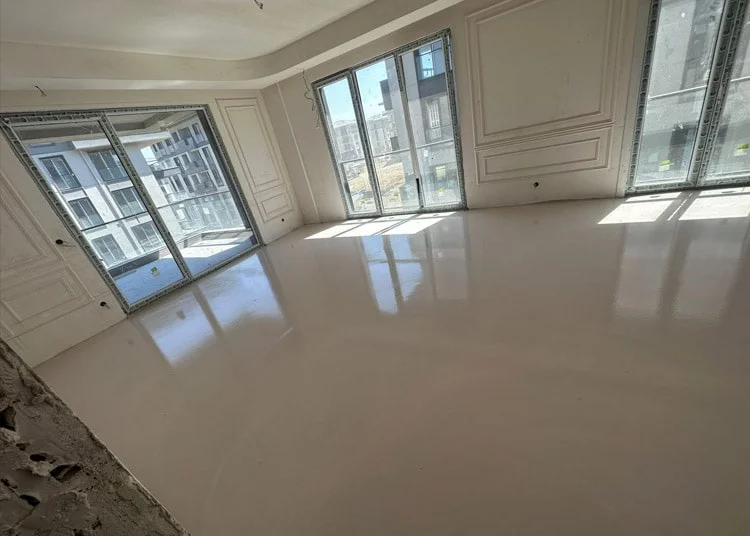
If no coating material will be applied over the treated area, a polish or sealer may be applied over the self-leveling screed.
The application must be carried out without interruption. To obtain a monolithic and smooth surface, the mixture should be prepared in more than one bucket. The prepared mixtures should be poured consecutively and spread continuously. Pumps may be used for very large areas.
To reduce splashing and air bubbles, the prepared screed should be poured from a height of approximately 20 cm.
The prepared self-leveling screed should be spread starting from the central area of the application surface. After the material is leveled, air bubbles must be removed immediately with a spiked roller. This process should not exceed 2–3 minutes.
Spiked shoes must be worn during application.
Water must not be added while the self-leveling screed is setting.
If a floor covering such as PVC, parquet, carpet, or similar material will be applied after the screed, approximately 3 days should be allowed before installation.
If there are joints in the substrate, the same joints must be carried through into the self-leveling screed application to prevent irregular cracking. Existing joints in the substrate must be transferred to the upper layer.
Consumption
Although consumption may vary depending on the product used, it generally ranges between 1.50 and 1.80 kg/m² for a thickness of 1 mm.
Product Types
Standard Self-Leveling Screed:
This type is used for general floor leveling applications. It is suitable for achieving smooth surfaces and can be used on various types of substrates.
Fast-Drying Self-Leveling Screed:
This type has shorter drying times. It helps speed up projects and reduces the time required before the area can be used. It is generally preferred for urgent projects that require fast delivery and quick use.
Fiber-Reinforced Self-Leveling Screed:
Fiber-reinforced screed contains steel or glass fibers. These fibers help prevent crack formation and increase the durability of the screed.
Colored Self-Leveling Screed:
Colored self-leveling screeds are used to meet aesthetic requirements. They offer different color options and can be adapted to interior design needs.